
Audio-book Review
By Chet Yarbrough
Blog: awalkingdelight)
Website: chetyarbrough.blog
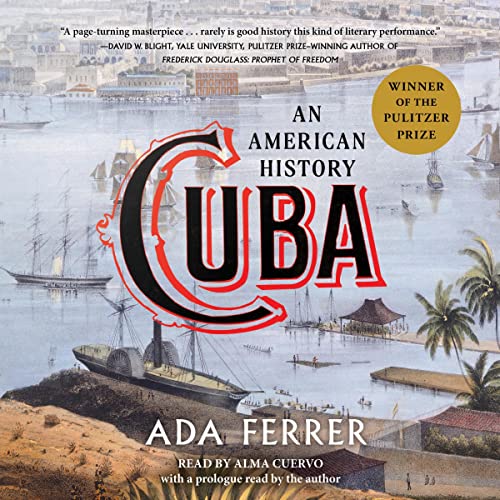
Cuba (An American History)
By: Ada Ferrer
Narrated by: Alma Cuervo, Ada Ferrer- prologue.

Ada Ferrer (Author, historian, winner of the Pulitzer Prize for her American History of Cuba.)
Ada Ferrer’s “Cuba” offers an insightful history of Cuba. She reveals how this island nation became a Spanish and American obsession and explains its complicated relationship with the world and America. In Cuba, Columbus finds three Indigenous inhabitants, the Tainos, the Ciboneys, and the Guanajatabeyes. Though Columbus may have tasted the sweetness of sugarcane, he was looking for gold and failed to appreciate sugar’s commercial value.
The Italian explorer, Christopher Columbus, lands in Cuba on his historic and misguided exploration of the Western world in 1492.


Spain becomes the de facto ruler of this island, less than four hundred miles off Florida’s coast. With Cuba’s declaration of independence in 1868, Spain’s control is challenged by years of Cuban rebellion until American intervention in 1898. Spain had colonized and controlled Cuba for over three hundred years. In 1898, America declares war on Spain and ejects Spain’s suzerainty in the Spanish-American War. However, Cuba fails to become truly independent until 1902 when the U.S. ends its military occupation. Ferrer notes in the years between 1898 and 1902, American leaders like John Quincy Adams covet American assimilation of Cuba. However, Cubans had other ideas.
Ferrer infers Cubans felt the same about America’s control of Cuba as they did of Spain’s. With liberation of Cuba in 1898, America chose to appoint the same Spanish bureaucrats to manage the country as when Spain controlled Cuba.

America influences election of a President of Cuba’s new Republic by supporting Thomas Palma. Palma lasts for 4 years. In general, Ferrer implies Cubans were glad to see America withdraw in 1909. However, American withdrawal is tempered by the Platt Amendment that would allow American military intervention if American leadership believed Cuban independence was at risk.

Cuba neglected to form a government that could or would govern the inherent self-interest of human beings.
Failure to understand human self-interest exacerbates the economic challenge of the Great Depression. The first act of one of Cuba’s kleptocrats in the early 1930s is to pilfer the treasury, escape to America, and build what became known as “Little Havana” in Florida; leaving Cuba without funds to govern their newly formed government.


Cuba’s kleptocratic government copes through the years of the depression to become fertile ground for the American mob, led by Lucky Luciano and Myer Lansky. Lansky meets with Batista and hands over suitcases of money to cement a relationship between the mob and the Cuban government. Lansky establishes a Cuban gambling industry and makes Cuba a transportation hub for illegal drug distribution.
Ferrer notes at times in history, the conflict between Black and white citizens becomes as violent in Cuba as in America.

In subsequent years, Cuba writes a new constitution that theoretically guarantees social equality but fails to enforce its idealistic intentions. Considering Ferrer’s studied and detailed history of Cuba’s government struggles, a reader/listener recognizes the wisdom of America’s founding fathers in creating a government of checks and balances. One realizes Cuba runs through several Presidents that fail to achieve the ideals of their Constitution. The ideal of equality among men and women of all races and creeds, though preached in both Cuba and America, is not achieved in either country.
Ferrer recounts the story of Lucky Luciano carrying suitcases filled with money to corrupt Batista’s government to transform Havana into a mecca for gambling and prostitution.
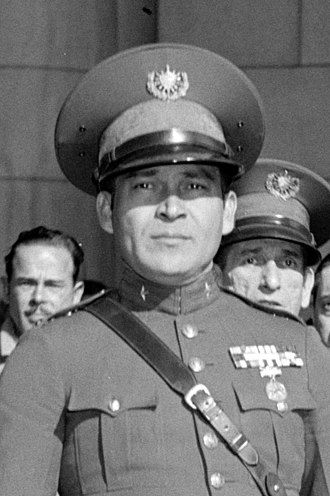
Fulgencio Batista (1901-1973) U.S. backed dictator of Cuba.
After a series of difficulties in the economy, Fulgencio Batista becomes President in 1940 and again in 1955 after a seven-year interregnum with two other Cuban Presidents.
Ferrer notes Cuba in later days of Batista and during the depression is a kleptocratic state. The failure to establish a government that serves its people rather than its corrupt leaders, and Batista’s cruel administration set the table for citizen’s discontent and rebellion. That discontent led to Fidel Castro’s rise to power in 1976.

Fidel Castro (1926-2016) Photograph in 1959. Castro served as President and then Secretary of the Central Committee of the Communist Party of Cuba but always considered himself a Socialist.
Ferrer clearly explains Castro was a committed revolutionary socialist, not a communist. Castro makes the same mistake China and Russia are making in understanding the economics of Karl Marx. This is not to say Marx is right about the evolution of government but that the ideal of a socialist’s or communist’s success is dependent upon economic growth. Without wealth, there is no equity to equally distribute.
Ferrer shows Castro to be an idealist, a person committed to the equality of humanity but unable to create the economic viability needed for socialism to work.

Fidel Castro is both revered and reviled by Cubans, let alone many Americans. The inherent self-interest of humanity makes socialism and communism an ideal, not a reality. Neither China, Russia, nor Cuba, seem to understand, as Marx infers–to become either a socialist or communist state, a state must begin with capitalism.
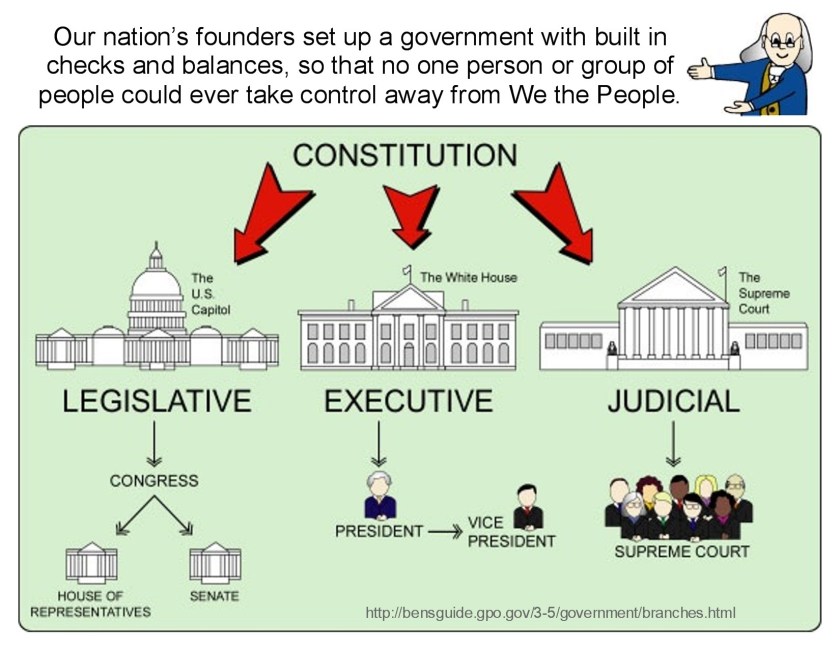
Self-interest will always interfere with the idealism of socialism and communism. The missing requirement of all forms of government is the perfection of checks and balances that can fairly mitigate inherent human self-interest.
“Cuba” is an excellent historical account that illustrates the strength and weakness of autocratic leaders and government idealism. Ferrer’s work deserved the Pulitzer Prize.

 REVIEWS AND VIEWS OF LIFE