

Books of Interest
Website: chetyarbrough.
Other People’s Money (The Real Business of Finance)
By: John Kay
Narrated By: Walter Dixon

Sir John Anerson Kay (Author, CBE, FRSE, FBA, FAcSS, British economist, dean of Oxford’s Said Business School.)
John Kay explains how the world’s finance system was designed to support national economies and international trade. However, he argues the world’s financial system, though designed to improve the lives of everyone, has evolved into a system that primarily benefits those within the financial industry, not everyone.
Kay offers the example of Ponzi schemes like that created by Bernie Madoff, and mortgage derivatives created by financial quants. Unlike Madoff’s personal enrichment, the financial industry’s’ mortgage derivatives enriched mortgage lenders, banks and brokers who sold them to other financial institutions like hedge funds, investment banks, mutual funds, foreign and retail investors. Mortgage derivatives were a national Ponzi scheme, greater than Madoff’s, that only enriched the financial industry. In 2008, the financial industry nearly bankrupted the world. The finance managers served no jail time while poorly qualified homeowners were thrown into the street because they could not afford their home mortgages.

What is puzzling is how so many people lost their homes in 2008 despite government regulation of the financial industry, which was ostensibly designed to protect consumers and stabilize the housing market.
“Other People’s Money” is managed by financial institutions that have nothing to lose if other people’s money is lost. A poor finance industry manager might lose his/her job because of poor sales received for selling financial products to other financial companies. However, if their sales are good, huge bonuses are given to top earners. Kay notes three faults in this system. One, it is a closed system that primarily feeds on itself as an industry. Two, the product of sale can as easily be worthless as valuable. And three, the money that is being used is primarily the public’s money, not the financial industries’ money. Mortgage derivatives became weapons of mass financial destruction. The public suffered more than the financial industry for the obvious reason that it was the public’s money.
In theory client funds are kept separate from a firm’s own assets. Though that may be true, the equity of lenders is small in relation to the loans made to others because the loan actually comes from “Other People’s Money”, i.e., those who deposit their paychecks in a financial institution. There are government entities like the SEC in the US that enforce separation of a lender’s equity from other people’s money but so what? Other people’s money is the bulk of what is lent out to others.
An example of the perfidy of the financial industry is the creation of mortgage derivatives that resulted in big bonuses to financial industry employees while many American citizens lost their homes.

Government regulations require record-keeping, transparency and risk management. So why did so many people lose their homes in 2008 while lenders were bailed out? If the Government regulated how other people’s money was being invested, how did the 2008 mortgage crises occur? It occurred because of the way the financial industry is regulated and the greed of financial institutions in selling a product that had less value than realized until it was too late. The fault within the industry grew bigger based on the packaging and resale of other people’s money in a product that became worthless.
The point is that there is little equity from money lenders that use “Other People’s Money” to invest in the economy. Financial institutions are required to have as little as 4.5 percent to 6 percent equity in loans for what they lend to others. The remainder is “Other People’s Money”. Most of the risk of institutionally loaned money is born by the public. Of course, there are insurance guarantees from the government, but they are limited.

Kay notes financial industries are motivated to expand their businesses by capitalizing on short-term gains for profit rather than long-term stability and growth.
Kay goes on to explain that financial institutions are the biggest contributors to candidates for public office. Just as the Supreme Court’s decision to give corporations personhood, the influence of corporate America distorts the influence of American citizens. Naturally, financial institutions push for favorable regulations designed to benefit owners and managers of the finance industry. He explains how financial risk is designed to fall back on taxpayers and less informed investors. Because financing institution managers are using other people’s money, they are more concerned about lender profit and their bonuses than loan default. Kay suggests there is a lack of transparency that hides the exploitive nature of lending that has minimal personal risk to lending institutions, its managers, and loan officers.
Kay argues financial products and services need to be simplified and made more transparent so consumers can understand how lending institutions and insiders are benefiting from their transactions.
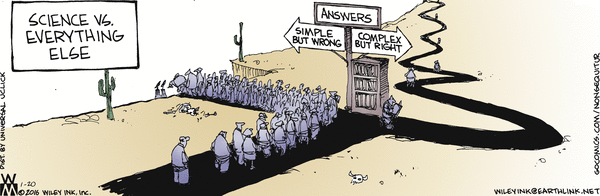
Kay explains the primary functions of the financial industry should be focused on making payments simple with clearer explanations of risks so that capital is efficiently and wisely allocated. Government oversight should be exercised to promote transparency, accountability and long-term stability of the economy. Training in ethical behavior and financial responsibility is needed for agents of the financial industry so that incentives and rewards balance with the needs of the economy.

Kay suggests regulatory reform is necessary with greater transparency, and accountability for long term financial stability. He calls for more training in ethical behavior and fiduciary responsibility in the financial industry. Kay believes “too big to fail” financial institutions should be broken up to reduce risk and encourage competition.
 REVIEWS AND VIEWS OF LIFE