CARTOON

Nadel reports Robert Crumb’s life and antics without criticism which seems appropriate because he is simply recounting a human beings’ life. Nadel does not act as a judge but as a reporter of a lived life.

Books of Interest
 Website: chetyarbrough.blog

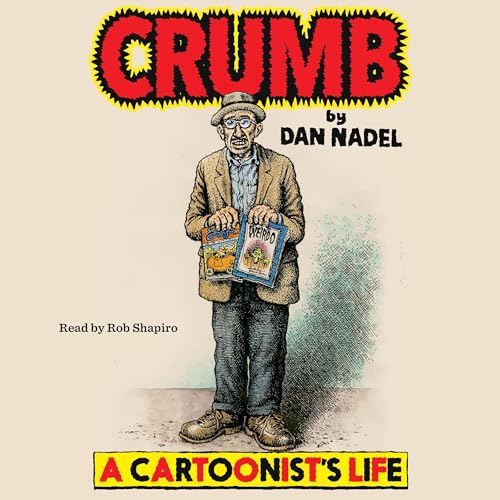
Crumb 

Author: Dan Nadel

Narrated By: Ron Shapiro

Dan Nadel (Author, curator-at-large for the Lucas Museum of Narrative Art in Los Angeles.)

“Crumb” is a well written biography of Robert Crumb, the cartoonist. The subject matter is of interest to me because of the remarkable talent of a disheveled young man with coke bottle glasses that has a gift of drawing. That gift provides him wealth and success despite coming from a troubled household that gives him an eye for the weirdness of life. He and his brother, Charles who was 1 year older, began a monthly hand-drawn comic book when he is 15 years old. They sold it door to door in the late 1950s. Charles wrote the stories and Robert illustrated them. Nadel shows how that early life experience sharpened Robert’s artistic skills and planted the seeds for his future success.

R. Crumb drawing of himself.

Nadel notes how Crumb’s drawings are deeply personal and sometimes disturbing because they capture the inner conflicts within Crumb’s life while tapping into the undercurrents of postwar America. Crumb’s work delves into the male id and its impulses exposing sexual obsession, neurosis, and human alienation. Crumb’s life story borders on a confessional and makes one confront their own obsessions. His comics delve into consumerism and conformity about race and gender with a biting satire that makes one realize the absurdity of American, if not all, human life. Nadel suggests Crumb’s work is an unfiltered chronical of the life he lived and lives.
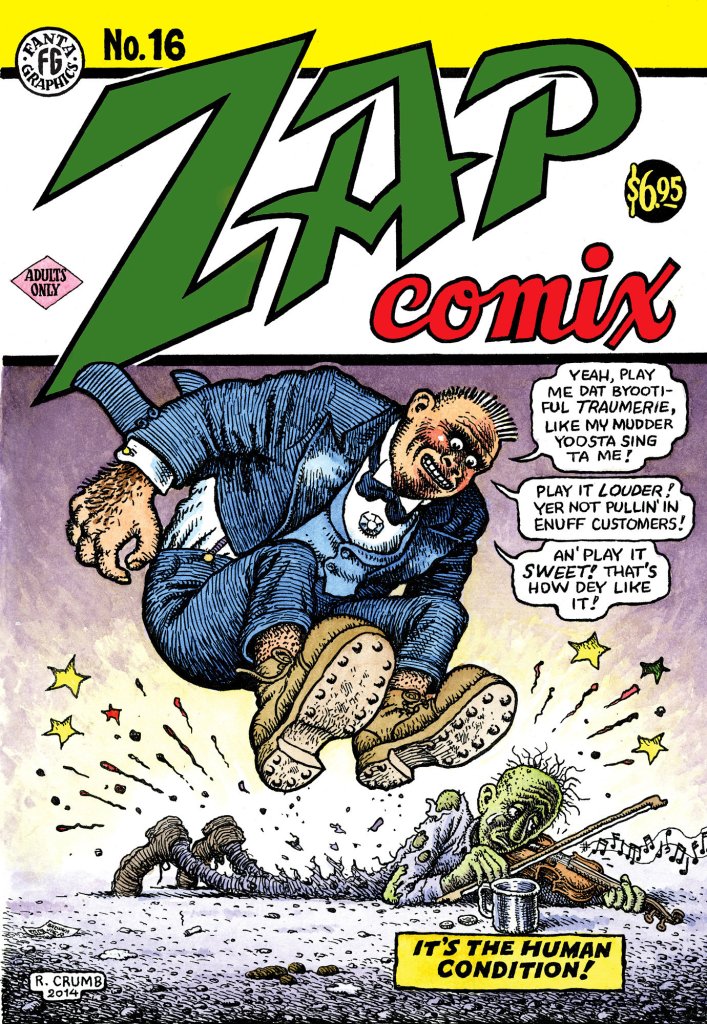
Robert Crumb gained fame in the 1960s counterculture when Zap Comix was released in 1967.

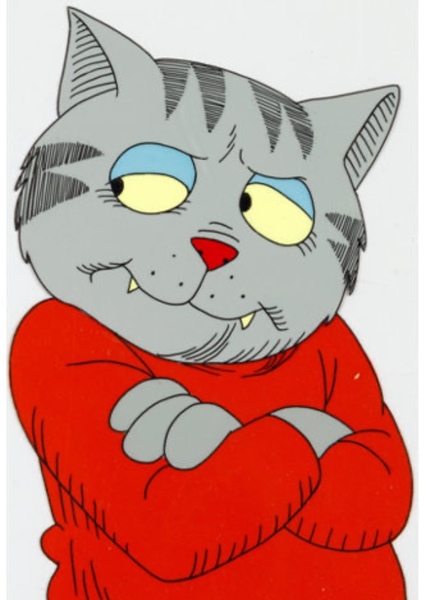
“Mr. Natural” and “Fritz the Cat” became cult icons illustrating the absurdity of life. Nadel suggests Crumb’s subjects are expressions of his working through his personal demons. Some of his images are racist and misogynistic which paints a picture of a troubled society. His subject matter ranges from popular music, counterculture, the history of comics, to graphic satire.
Nadel explains Crumb is married twice. His first marriage to Dana Morgan falls apart in part because of Crumb’s emotional volatility, but also because of the cultural upheaval of the 1960s. Nadel explains Morgan was the first woman Crumb had sex with which is complicated by Crumb’s confusion about sex. Crumb’s fame increases. He experiments with LSD. These dramatic changes in his life increase his discontent. There seems no single reason for the divorce. Crumb moves to San Franciso in 1967 to immerse himself in a counterculture and the comix scene.

Crumb meets Alaine Kominsky in 1972, and they marry in 1978. Their creative partnership blossoms with the creation of autobiographical comics that reveal the quirks, conflicts, and affections of their relationship. Their joint work is “Dirty Laundry Comics”. Ms. Kominsky dies in 2022.

Nadel notes that Crumb insisted on honesty when he agreed to have his biography written. Aline Kominsky is acknowledged as a stabilizing force in Crumb’s life. Crumb lived through America’s wars, the psychedelic age of the 60s and has now has reached the age of 81. Nadel explains much about Crumb’s turbulent life and how that turbulence shaped him and his art. Nadel offers a layered and empathetic portrait of R. Crumb, the ups and downs of his life, without excusing or condemning the beliefs, actions, or art of his long life.

Crumb’s behavior like jumping on the backs of women for piggyback rides and his racially charged imagery is uncritically reported.

Some of what Crumb illustrated in his art and what he did with his piggyback rides undoubtedly insults the public. In many ways, Crumb marginalizes society with his racist and misogynistic comics. Nadel reports Robert Crumb’s life and antics without criticism which seems appropriate because he is simply recounting a human beings’ life. Nadel does not act as a judge but as a reporter of a lived life.

Crumb’s parents were poor. He lived in poverty but overcame its limitations with the art of drawing that opened the world of commerce to him. From comics to greeting card drawings and back to comics, Crumb became a maven of the art of irreverent behavior.

LIFE’S DEMONS

A sad ending to a remarkable human being.

Books of Interest
 Website: chetyarbrough.blog

“Robin” 

By: Dave Itzkoff

Narrated By: Fred Berman

Dave Itzkoff (Author, American journalist, former culture reporter for the NYT.)

Dave Itzkoff produces an insightful and well written biography of Robin Williams. Robin Williams was a spectacular actor and comedic genius who brightened the lives of many while hiding a personal insecurity and a self-critical demon.

The author’s story is an audiobook delight because of its author and narrator. The narrator, Fred Berman, offers a reminder of Robin Williams incredible ability to entertain an audience with human observations and ethnic expressions that make one laugh.

Berman is not Robin, but he is enough of a mimic to help listeners understand the ways in which Robin was a genius. Itzkoff completes that categorization by explaining how Robin could read a script in one sitting and recite it verbatim at a next day’ rehearsal.

Williams became friends with famous future actors at Julliard.

Williams was admitted to Julliard as a promising actor. Julliard is noted for rigorous training, and imaginative daring. Julliard was an introduction to performance opportunities in New York city. However, his undisciplined character cost him the opportunity of graduating. Nevertheless, association with Julliard paid dividends in later years because of its reputation. One close friend was Christopher Reeves of Superman fame who, as is well known, became paralyzed later in life from a horse-riding accident. Reeves died in 2004, ten years before William’s suicide.

Williams was a father of two boys and a girl, born from two marriages. His first marriage ended after ten years with one child born in 1983, Zachary Williams. His second marriage to Marsha Garces lasts for two decades with the birth of a girl and boy, Zelda and Cody. Itzkoff implies both marriages end because of Robin’s self-critical demon. Robin lets the demon loose with insobriety. Drugs and alcohol magnify his fears and distort his relationship with others. Both marriages failed as alcohol and drugs entered, left, and reentered his life.

What was surprising to some who read this biography, were the number of movies Robin Williams worked in either as a lead or supporting actor.

Williams was in over 70 films, some of which became block busters. Some were duds but others received high acclaim. Among the most memorable were “Good Morning, Vietnam”, “Dead Poets Society”, “Awakenings”, “Mrs. Doubtfire” “Good Will Hunting”, and “Aladdin”. Some were bombs at the box office while these six had some negative reviews but blockbuster revenues. Williams received an Oscar for best supporting actor in “Good Will Hunting”.

Some think of Williams as a stand-up comic that reminds one of Jonathan Winters, a close friend of Robin’s.

Others remember the television show “Mork and Mindy” where Robin played a space alien coming to earth. The versatility of Williams is revelatory in Itzkoff’s biography. Itzkoff notes the many friends Williams had and how generous he was with his time and support of others. When Cristopher Reeve’s accident happened, the support offered by Williams is touchingly explained by Itzkoff.

Throughout the biography, a listener becomes aware of the destructive impact of drugs and alcohol on William’s life.

In his first marriage, William’s growing fame gave him access to all the cocaine he wanted. He comes to a realization that his addiction was out of control when John Belushi, his friend, dies in an overdose on the same night they were together. This was 1982. In 1988, his first wife, Valerie Velardi divorced him. In 1989, Williams married Marsha Garces.

Robin Williams’ demon does not disappear but becomes quiet in his mind as he becomes sober.

Williams life with Marsha broke him away from drugs and alcohol for several years. Williams and Marsha succeeded in having a daughter and son together. Marsha managed to get him away from the life of drugs and alcohol. The demon in Williams’ mind returned in the last years of his marriage to Marsha when he returned to drugs and alcohol. Williams hanged himself in 2014. He and his wife, Marsha were divorced. Sometime after his second divorce, Williams was married a third time.

A few months before his suicide, Williams was misdiagnosed with Parkinson’s disease.

It was found in autopsy that Williams had Lewy body dementia, a debilitating brain disease that is symptomatically similar to Parkinson’s. Williams’ demon was Lewy body dementia, a brain disorder that causes depression, anxiety, and paranoia. Clinically, LBD is caused by abnormal proteins. One wonders whether those abnormal proteins were always in Williams’ body. Were they always there or stimulated by his addictions? In any case, it was a sad ending to a remarkable human being.