
Audio-book Review
By Chet Yarbrough
Blog: awalkingdelight)
Website: chetyarbrough.blog
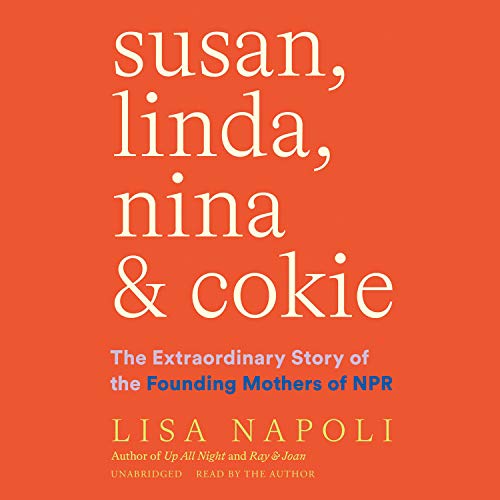
Susan, Linda Nina & Cokie
By: Lisa Napoli
Narrated by: Lisa Napoli

Lisa Napoli (American Author, Journalist, Broadcaster & Speaker.)
Lisa Napoli introduces four women, Susan Stamberg, Linda Wertheimer, Nina Totenberg and Cokie Roberts with “Susan, Linda Nina & Cokie”. They are known as the “founding mothers of National Public Radio”. Napoli shows NPR did not succeed solely because of these four women but their contribution to its ultimate success appears unimpeachable.

Napoli shows how these four women reinforce the truth and necessity of sexual equality. Equal rights have not been achieved in America (or anywhere in the world), but its struggle for women is exemplified by Napoli’s story.
All four women represent a movement for equal rights in America.

N.P.R. is created by the Public Broadcasting Act of 1967. The first broadcast to garner a national reputation is “All Things Considered”. It is co-hosted by Robert Conley, an American newspaper, television and radio reporter. The first program director of “All Things Considered” is Linda Wertheimer.

Linda Wertheimer (American radio journalist and Wellesley College graduate, directed the first “All Things Considered” N.P.R. program.)
The co-host of that program is Susan Stamberg.
Susan Stamberg (American Radio Journalist on N.P.R. who co-hosted “All Things Considered” with Robert Conley.)

The two most recognizable names in Napoli’s history of NPR are Nina Totenberg and Cokie Roberts because of their widely distributed commentary in television and newsprint. Totenberg’s supreme court news and Roberts political commentary gave them greater visibility and recognition by the public.


The story of these four women shows how important equal rights are in the world. One may argue something is lost while something is gained by families raised by working mothers. On the one hand, it seems disingenuous for someone from a rich family like Cokie Roberts to be pro-life (noted in Napoli’s book) because they have the wealth to pay for care of their children. On the other hand, as a former latch-key kid, one realizes every life is a matter of luck and circumstance.

The story of these four women infers every person finds their way and should live in a world where they have an equal right to choose their path.
There is no logical reason to believe women, or any race or ethnicity should not have equal rights. Some people are born in wealth, some in poverty, and some of one race, religion, or ethnicity. In a perfect world, there would be equal opportunity for every human being. Napoli shows America is not perfect, but it strives to improve. That becomes clear in Napoli’s last chapters that show how NPR nearly goes bankrupt because of financial mismanagement.
As noted earlier, women are not the only reason for NPR’s growth and success. As with all corporations, NPR has a management group that guides small corporations interested in becoming large corporations. The programing and growth success of NPR is initiated by its first President, Donald Quayle. After Quayle, Frank Mankiewicz becomes President (1973-1977). Rapid expansion of NPR outstrips prudent financial management of NPR’s ballooning operational costs. What is initially recognized as a 1.5-million-dollar deficit balloons to 6 million dollars. Mankiewicz is a political science and journalism graduate who had a great sense of promotion but a poor sense of cost control. Napoli notes Hunter Thompson, in “Fear and Loathing on the Campaign Trail ’72” described Mankiewicz as a “rumpled little man who looked like a used-car salesman”.

NPR is on the edge of bankruptcy when Douglas Bennet Jr. takes over the presidency, beginning in 1983 and ending in 1993.

By 1983, NPR, through a donation system and prudent financial management, returns to solvency. Through a combination of dues and fees paid by member stations, underwriting from corporate sponsors, and annual grants, NPR survives.
The elephant in the room is reserved for an epilogue in Napoli’s history of NPR. Napoli explains Nina Totenberg’s investigation of Clarence Thomas as he defends himself from his boorish behavior toward Anita Hill. Every rational human being recognizes Hill is sexually harassed by Thomas, but the tenor of those times was to ignore rather than vilify misogyny. With Biden as the chair of the committee to approve his nomination, Thomas becomes a Supreme Court justice. Totenberg and Thomas become famous, and Hill becomes a footnote in history.
Anita Hill as she appeared in the Clarence Thomas hearings for appointment to the Supreme Court in October 1991.

Napoli does a good job explaining the history of what many consider an American national treasure. Of course, others argue NPR is no treasure, but a bastion of liberalism designed to undermine American conservatism.

 REVIEWS AND VIEWS OF LIFE