
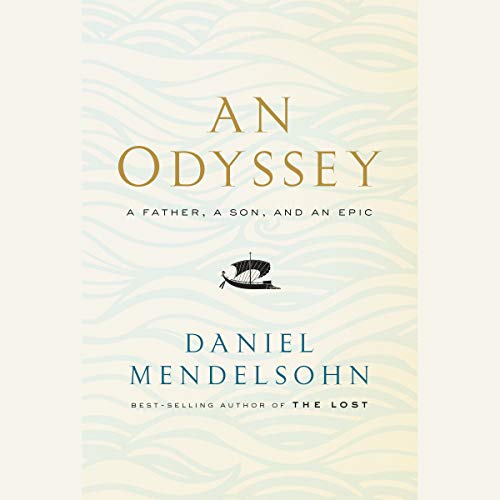
Books of Interest
Website: chetyarbrough.blog
“An Odyssey” A Father, a Son, and an Epic
By: Daniel Mendelsohn
Narrated By: Bronson Pinchot

Daniel Adam Mendelsohn (Author, essayist, critic, columnist, and translator, Professor of Humanities at Bard College.)
“An Odyssey” is a memoir that combines Mendelsohn’s life and educational experiences with Homer’s “… Odyssey”. As most know, “The Odyssey” is one of two ancient Greek epic poems, the other being “The Iliad”. Both are attributed to Homer who is questioned by some scholars as neither the soul creator nor (necessarily) its singular author. Both poems are said to have come from an oral tradition in ancient times, told and re-told, with no written editions until the late 8th or early 7th century BCE. Homer is believed to have lived in the 9th or 8th century BCE which makes it possible for him to be the originator, but no one really knows. Homer seems a singular source, or one of many who told and retold the epic poems.

“An Odyssey” is a tribute to Mendelsohn’s father, his intellect and his impact on his son’s understanding of life. Mendelsohn cleverly intersperses “The Odyssey” of the heroic life of Odysseus with the accomplished life of his father.
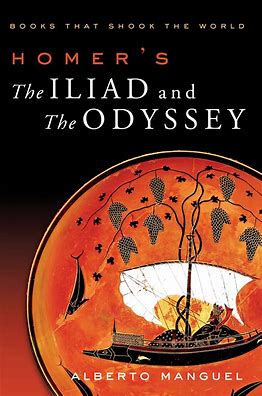
The two poems tell the history of the Trojan War with the main character of “The Iliad” being Achilles, while Odysseus is the main character of “The Odyssey”.
Both heroes are characterized in “The Odyssey”. Achilles is recalled as the greatest warrior of the Trojan War who dies as a hero. Odysseus is also a warrior but is noted as a strategist who skillfully manipulates others with his cunning wit and intelligence. In Odysseus’ return, he meets Achilles in a nether world to find Achilles regrets his fate. Achilles explains he would have rather continued in life than being remembered by the living as heroic in the nether world of death.
Daniel Mendelsohn, like Odysseus, is a witty teacher who uses his intelligence to dissect “The Odyssey” by giving listeners a memoir of his relationship with his father.

In that dissection, one gains some understanding of “The Odyssey” while glimpsing what it was like to be raised by a loving but strict father.

What Mendelsohn introduces is every father’s role in raising children.
A theme that runs through “The Odyssey” is Odysseus’s troubled ten-year journey to Ithaca after the Trojan war but what Mendelsohn introduces is every father’s role in raising children. Mendelsohn’s father is nearing the end of his life. He is a retired engineer who worked for the American government on high security projects before becoming a professor. In retirement, his father chooses to attend his son’s class on “The Odyssey”. Mendelsohn combines his father’s attendance in his class with a real and reimagined trip they take to retrace Odysseus’s travels in “The Odyssey”.
Mendelsohn’s father has strong opinions about the character of Odysseus, and he expresses them in class.
Mendelsohn’s father characterizes Odysseus as a poor leader who lost all his men in his return to his homeland. Mendelson’s father gives the example of the cyclops who imprisons and eats some of Odysseus’s men but, after a clever escape, Odysseus foolishly chooses to taunt the cyclops. The cyclops nearly sinks the ship and appeals to Poseidon to kill the escaped sailors (none of which survive) because of Odysseus’s taunt. Mendelsohn’s father characterizes Odysseus as a poor leader of men, a braggart, liar, and cheater on his wife, Penelope.
There is a sense of the Professor learning many things about his father from discussions in the class. At the same time, listeners gain personal knowledge of the epic poem, its universal meaning, and why it is considered a classic. From the class discussion about Telemachus, the son of Odysseus, one realizes the tale is about the role of fathers and, to a lesser extent, mothers in educating their children. Mendelson admires his father for his intelligence, fidelity and what he believes is unbending truthfulness. On the other hand, Mendelson is embarrassed by his father’s slovenly dress, eating habits, and what he perceives as his father’s parental neglect during his childhood.
Mendelsohn’s father does not fear death but is afraid of the mental and physical deterioration that comes before death.
Mendelsohn seems hurt by his father’s emotional distancing but becomes less hurt as he gains a clearer understanding of where that distancing comes from. Mendelsohn’s father lives in a black and white world. Everything is one way or another. The end of one’s life is often gradual and only becomes one way or another at the very end. There is an inkling of tragedy to come as his father finally dies.
Truth and a lie are two sides of a coin. The fear of losing one’s physical or mental abilities is not a choice but something beyond one’s control.

Understanding what is black, white, true, or false loses meaning as one nears the end of life. Mendelsohn’s father has lived a life where he depended on himself. He made his own choices. As one’s body or mind deteriorates, depending on oneself become problematic. That loss of control is the fear of Mendelsohn’s father. Here is the tragedy of Mendelsohn’s story.
Mendelsohn’s father’s life is extended by the desires of his family and his doctor’s ministrations, despite the diminishing quality of his father’s life. Mendelsohn’s brilliant father lives months after his debilitating stroke. The only point one can see in the extension of life when death is imminent seems to be a family’s grief, and a kind of selfishness over loss of a loved one. There seems a high degree of selfishness in extending the life of one who is at the end of their life.

As a father, there is much more to be learned in Mendelsohn’s story about what it means to be a good father.
One recognizes the many mistakes a father or parent can make in their lives in failing to be the best they can be for their children.

 REVIEWS AND VIEWS OF LIFE