
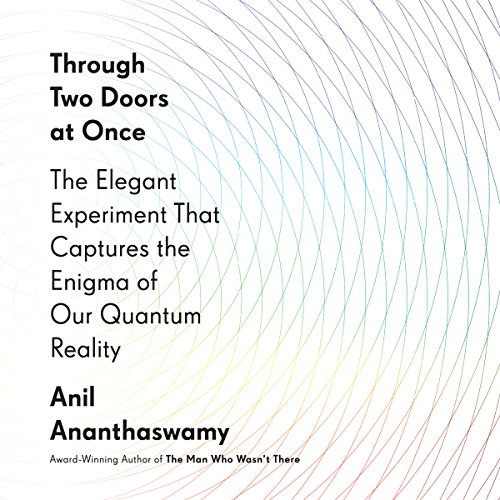
Audio-book Review
By Chet Yarbrough
Blog: awalkingdelight)
Website: chetyarbrough.blog
Through Two Doors at Once (The Elegant Experiment That Captures the Enigma of Our Quantum Reality)
By: Anil Ananthaswamy
Narrated by: Rene Ruiz

Anil Ananthaswarmy (Indian author, and science journalist, Journalism Research fellow at MIT.)
Anil Ananthaswarmy makes a valiant effort to explain the “…Enigma of Quantum Reality” with “Through Two Doors at Once”. It takes a writer’s courage and determination to explain what science presently understands about quantum physics; particularly, to someone whose education is limited to reading and liberal arts.
Ananthaswarmy notes Einstein acknowledged the truth and value of quantum physics.

However, Einstein believes quantum mechanics proof only explains an aspect of life in the universe. Einstein insists underlying fundamental laws of physics are undiscovered which will reaffirm all life exists in a cause-and-effect, rather than probabilistic, world. Einstein is presumably surprised, if not disappointed, by the growing experimental confirmation of quantum mechanics that destroys his locality theory of physics and presents a mystery of entangled particles that seems to violate the speed of light.

Ananthaswarmy’s history of the quantum world is like the difference between Newton’s physics laws on earth and Einstein’s physics laws in the universe.
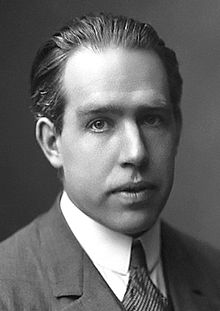
Both Newton and Einstein argued life exists in a cause-and-effect world, but quantum mechanics theorists, Bohr (on the left below) and Eisenberg, and many of today’s scientists suggest otherwise. They believe life on a microscopic scale is probabilistic, not ordered by cause and effect as implied by the classical physics of Newton and Einstein.
“Through Two Doors at Once” is a history of experiments that confirm the probabilistic nature of quantum mechanics. The theory of quantum mechanics implies the nature of reality is probabilistic. Einstein fully acknowledges the validity of quantum mechanics as a part of the physics of life but insists there is a more fundamental law of physics, not defined as probabilistic. In Einstein’s and some scientist’s opinions that undiscovered fundamental law of physics will confirm life exists in a cause-and-effect, rather than probabilistic, universe.
Ananthaswarmy gives listeners the history of differences of opinion about the nature of reality. Some may think–why care?
Isn’t existence all that matters? Others suggest it matters because understanding the nature of reality changes belief in ourselves. Are humans in the universe more important than rocks, plants, or other forms of existence? There is no answer in Ananthaswarmy’s book, but it is a good summary of how science has different views of the fundamental laws of nature.
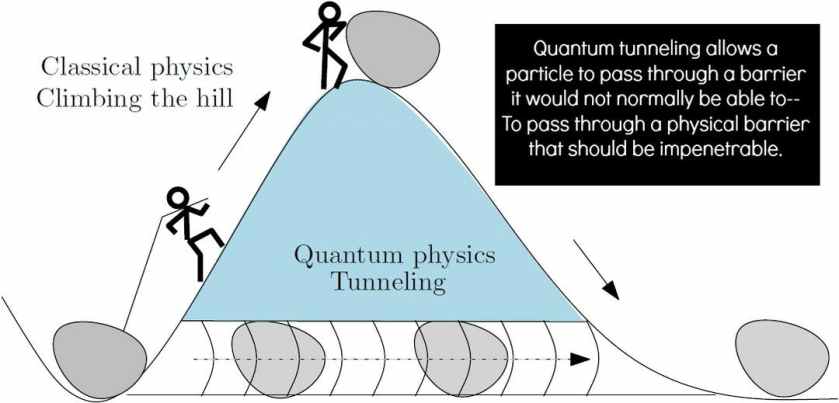
The point is that existence of quantum mechanics implies whatever one does in the world may not have predictive meaning, only endless probabilities.
At a microscopic level, quantum mechanics implies reality is a matter of chance, not cause and effect. Quantum mechanics denies predictability unless, as Einstein insisted throughout his life, we live in a world that has a natural law that explains all life’s consequences are based on defined actions.
Einstein’s holy grail is a physics theory that explains everything about everything.
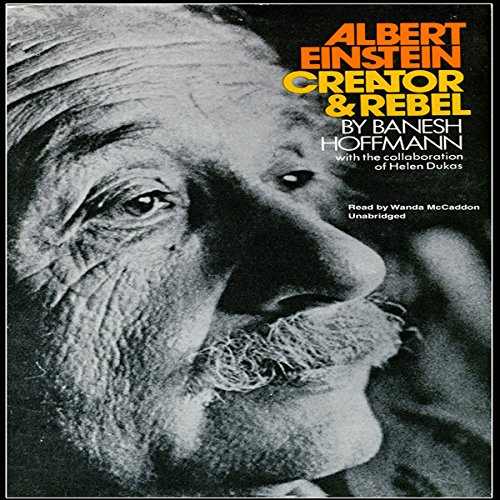
Followers of Einstein’s classical physics may believe in quantum mechanics but only see it as a part of reality, not a complete theory of reality. After all, 68% of the universe is dark energy and 27% is dark matter. Everything observed by humans constitutes a mere 5% of the universe.
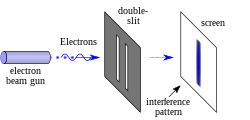
The idea of a “two split experiment” isolates a single proton or electron to test the theory of quantum uncertainty. (An experiment first performed by Thomas Young in 1801.)
What is amazing about Anathaswary’s history is how inventive scientists have been in proving quantum mechanics is real. That amazing accomplishment leads to proof that physics reactions are not only local but exhibit spooky action at a distance (entanglement). With as much of the universe’s energy and matter not observable, it seems Einstein had a point in suggesting quantum mechanics would be drawn back into a “cause and effect” world. As recent as this week, the activity of muons in dark energy suggests there is more to the story of the predictability of life.
The building of a mechanism to isolate one elemental particle of an atom for a “two split experiment” boggles the uninformed mind. Ironically, human inventiveness gives one confidence that Einstein’s goal of a unified theory of everything is conceivable. It seems a matter of time for science to discover what makes life real. Ananthaswarmy’s “Through Two Doors at Once” gives hope for young scientists, like the 26-year-old Einstein, to guide humanity to the meaning of life. Hopefully, before humanity kills itself with two-edged discoveries like e=mc2.

 REVIEWS AND VIEWS OF LIFE